

Custom PTFE Tube and Rod Solutions Engineered for Demanding Applications
2026-10-28
When off-the-shelf PTFE tubes and rods fall short, the real work begins. Demanding applications don't just need a material—they need a partner who understands the precise tolerances, chemical exposures, and thermal swings your design will face. At TAIFNO, we've built our reputation on turning complex fluoropolymer challenges into reliable, custom-engineered components. From high-purity fluid paths to wear-resistant structural parts, this guide explores how tailored PTFE solutions can eliminate compromise and keep your most critical systems running longer.
When Standard PTFE Stock Falls Short
Standard PTFE has a well-earned reputation for chemical resistance and low friction, but it starts to show its limits when you push beyond gentle operating conditions. In sealing applications, for example, pure PTFE tends to cold flow under sustained load. That means a gasket or O-ring can slowly deform and lose its ability to hold a tight seal, especially if the system cycles between high and low temperatures. Once that deformation sets in, retightening bolts rarely fixes the root problem—the material itself has moved out of shape.
The same weakness appears in dynamic parts like bushings or wear rings. Unfilled PTFE has a low coefficient of friction, which sounds ideal, but its load-carrying capacity is modest. Under even moderate pressure, the surface can wear quickly or extrude from the bearing housing. Users often mistake this for a lubrication failure, when in reality the polymer is simply too soft for the job without reinforcement.
Temperature is another trigger. Standard PTFE starts to lose mechanical strength well before its advertised maximum service temperature, and at elevated heat combined with load, creep accelerates. If you need dimensional stability in a precision component, or you’re asking the material to survive repeated thermal shocks without losing torque on fasteners, standard stock grades will not hold up. That’s when filled PTFE compounds—or switching to a different high-performance polymer—become the only practical path.
Cutting Rod and Tube to Your Print, Not Ours
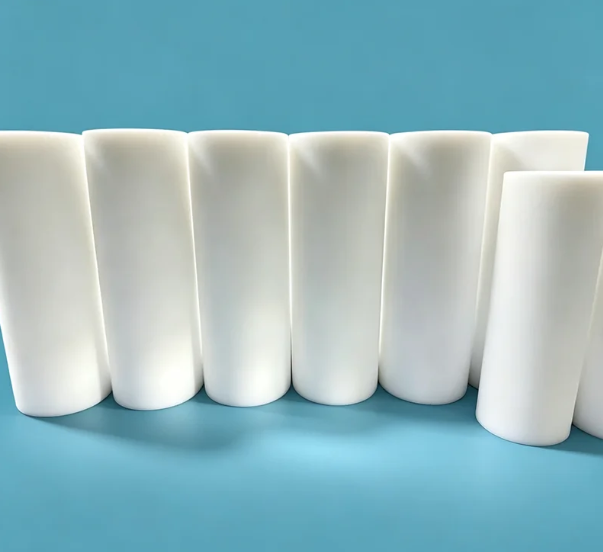
You send us the exact lengths your design calls for, and we cut each rod or tube to those numbers—down to the fraction of an inch. No more buying standard stock and trimming it yourself in the shop, hoping the cut stays square. We treat your drawing as the only source of truth, so the pieces arriving at your door already match what’s on the page.
That means less scrap in your bin and fewer surprises during assembly. Instead of juggling off-the-shelf sizes that almost fit, you get material that drops straight into your jig or fixture. If your project needs a 37-5/8 inch length with a clean, deburred end, that’s exactly what leaves our saw—not whatever we happened to stock last month.
We find this approach works especially well for one-off builds, repair jobs, and tight production runs where every inch counts. Tell us the alloy, diameter, wall thickness, and cut list. We’ll handle the measuring and cutting so you can spend your time welding, machining, or assembling instead of correcting our idea of a standard size.
Tight Tolerances Without the Typical Lead Time
Most shops treat tight tolerances as an excuse to stretch delivery dates. We don’t. Our machining cells are set up to hold ±0.0002 inches on critical bores and ±0.0005 inches on profile surfaces without slowing down the queue.
The trick is in the process, not the promises. We use temperature-stabilized metrology, in-process probing on every part, and tool presetting that removes guesswork from the first cut. That means a batch that would normally sit for three weeks leaves our floor in six days, with inspection reports attached.
If your current supplier treats precision as a premium add-on or a reason to push back your launch date, it’s worth a second look. We built the workflow around reducing non-cutting time, so the tolerance doesn’t become your bottleneck.
Chemical Baths, Cryo Rigs, and Other Places These Parts Go
You won't find these components sitting on a shelf in some dusty stockroom. They get dunked into acid baths that strip away oxidation and leave the surface microscopically clean, ready to bond. Then there are the cryo rigs, where the same parts are chilled to temperatures that would crack ordinary steel, all to test whether they can survive a sudden thermal shock without warping. It's not glamorous, but it's where the real work happens.
Beyond that, these pieces end up in vacuum chambers, ultrasonic cleaners, and salt-spray booths. Each station does one thing: expose a weakness. If a part comes out of a chemical bath with pitting, it's rejected. If the cryo cycle makes the grain structure brittle, the batch goes back to the foundry. There's no shortcut, and the people who run these rigs don't care about how nice a part looks on a spec sheet—they only trust what survives the process.
That's the hidden life of these components before they ever get installed. They spend days being soaked, frozen, shaken, and sprayed, moving from one harsh environment to the next. Anyone who thinks manufacturing is just machining and assembly hasn't seen the back rooms where the parts earn their place. By the time one of them finally ships, it has already been through more abuse than most finished products will ever see in service.
Small Runs, Big Runs, and the Same Attention to Detail
Whether a client orders ten units or ten thousand, the approach remains unchanged. Each piece moves through the same calibration checks, the same color matching under controlled lighting, and the same final hand inspection before it leaves the floor. There's no shortcut for a short run, and no relaxation for a long one.
Many shops treat small orders as practice or filler, pushing them through with less care because the margin feels thinner. That's a mistake. A one-off prototype or a limited batch often carries the highest expectations—it's the sample that secures a larger contract, or the gift that represents a brand at a single event. Sloppiness there costs more than rework; it costs trust.
Conversely, big runs create their own kind of drift. Repetition invites complacency, and a tiny variance early on can compound into visible inconsistency by the ten-thousandth unit. So the same operator checks density at regular intervals, the same log records every adjustment, and the same tolerance window applies from first piece to last. Scale changes the logistics, not the standard.
What Changes When Your PTFE Partner Actually Listens
真正的倾听不是点头说“收到”,而是当你提到某个法兰在低温下出现过微漏,他们会立刻追问密封面的粗糙度、螺栓预紧力,甚至你上次更换垫片的扭矩记录。你原本只是随口抱怨一句“这批板子尺寸飘了”,下次到货时却发现每张板都附了三次不同位置的厚度实测表,公差从±0.3压到了±0.08。这种变化不是来自邮件里多抄送几个主管,而是车间里有人把你的问题当成了自己的返工单。
更明显的信号是,他们开始在你之前提出问题。你还没说出口介质里混了少量氢氟酸,他们已经把填料方案从硅藻土换成了硫酸钡,并在装箱单上注明“不建议与玻璃纤维垫片混用”。当你第三次修改加工图纸时,没有收到“请确认最终版”的自动回复,而是一通电话:“这个位置的焊缝余高如果超过0.5,PTFE衬里在热循环下会鼓包,我建议改成搭接焊,成本不变。”这种判断来自对几十次泄漏事故的复盘,而不是来自产品手册的免责条款。
到最后你会发现,你不再需要准备三页纸的背景说明。他们会记得你上次的泵是衬四氟离心泵,介质温度上限是150°C,这次你问耐负压的管道,他们直接排除了纯PTFE模压管,推荐了带金属网增强的缠绕管,并附上两张在-0.09MPa下做了72小时蠕变测试的照片。这种对话效率的提升,本质上是因为他们把你过去所有零散的抱怨、临时的调整、失败的尝试都装进了自己的工艺库里,而不是当成客服工单关闭。
FAQ
They are machined from virgin PTFE and maintain dimensional stability even when exposed to aggressive acids, solvents, and oxidizers at elevated temperatures. We also offer filled grades for improved wear resistance where media compatibility allows.
Yes. Our turning and extrusion processes routinely hold tolerances down to plus or minus 0.001 inch on outer diameters, and we can supply rods and tubes cut to exact lengths with chamfered or squared ends to match your assembly needs.
We support semiconductor fabrication, medical device manufacturing, chemical processing, food and beverage, and aerospace. Each sector gets material certifications and lot traceability that align with its compliance requirements.
We do. Common fillers include glass fiber, carbon, graphite, and bronze. These blends increase compressive strength, reduce creep, and improve thermal conductivity while retaining the low friction and broad chemical resistance of PTFE.
We accept small batch requests and can turn around machined prototypes in as little as five business days. You receive the same material traceability and inspection reports as full production quantities.
Standard virgin PTFE performs continuously from minus 200 degrees Celsius to plus 260 degrees Celsius. For applications with intermittent spikes or lower outgassing needs, we can suggest modified PTFE or specific filled grades to better suit the operating window.
Certain grades meet FDA 21 CFR 177.1550 and USP Class VI requirements. We can provide supporting documentation when your application involves direct or indirect food contact or pharmaceutical processing.
Our standard machined finish is smooth and non-porous, typically around 16 to 32 microinches Ra. If you need an optically clear or enhanced sealing surface, we can polish to below 8 microinches Ra on request.
Conclusion
Standard PTFE tube and rod often arrive with dimensions that force you to redesign around the material instead of the other way around. When off-the-shelf stock falls short, custom machining becomes the only practical route—cutting rod and tube to your print, not asking you to accept a near match. Tight tolerances are held without stretching delivery timelines, so a part that fits a chemical bath flange or a cryogenic seal lands ready to install rather than needing hand finishing. The environments these components enter are not forgiving: aggressive acids, thermal cycling from ambient to cryogenic temperatures, and constant mechanical load all punish any inconsistency in wall thickness or concentricity. A custom PTFE solution addresses those failure points at the design stage, not after a leak stops production.
The same care extends across order size. A five-piece prototype run receives the same inspection routine as a five-hundred-piece production batch. Small quantities are not treated as an afterthought, and large runs do not become an excuse for relaxed dimensions. What changes when a PTFE supplier actually listens is the quality of the conversation itself: clarifying whether a rod needs a specific diameter for a valve seat or whether a tube must maintain a precise inner bore under thermal expansion. When the partner understands the operating conditions, the result is a component that drops into place without rework, keeps maintenance intervals predictable, and removes the usual back-and-forth over tolerances and lead times.
Contact Us
Contact Person: Tommy Xiao
Email: [email protected]
Tel/WhatsApp: 8615651509888
Website: https://www.ptfe-factory.com