

How Original Contact Plate Freezer Manufacturers Ensure Rapid, Uniform Freezing
2026-11-16
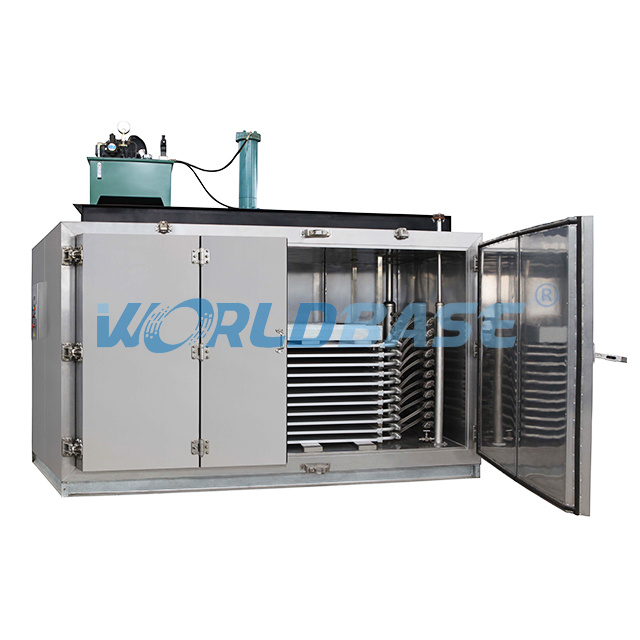
Achieving rapid, uniform freezing isn’t just about dropping temperatures—it hinges on how original contact plate freezer manufacturers manage plate contact, refrigerant flow, and loading patterns. Behind the most consistent results, you’ll often find engineering-driven brands like Worldbase pushing these variables to their physical limits. Here’s what sets their approach apart.
Perfecting Plate-to-Product Contact for Maximum Heat Transfer
Getting heat to move quickly and evenly into your product starts with solid, uninterrupted surface contact. Even the slightest gap between a heating plate and what you’re warming acts like a thermal bottleneck, trapping energy on the wrong side. You can feel this when a pan rocks on a stovetop or a heat exchanger plate barely kisses a material edge—those spots stay stubbornly cool while the rest risks overheating. The fix isn’t about cranking up the temperature; it’s about eliminating the pocket of trapped air or uneven spacing that turns efficient conduction into sluggish, patchy warmth.
Surface finish is rarely just for looks. A plate that’s engineered to be flat within microns, with a slight brushed or polished grain, actually creates more true contact points once pressure is applied. This matters even more with flexible or textured goods, where conforming the plate’s face to slight surface variations stops micro-insulating voids from forming. In practice, watch for stress warping during heating cycles—a plate that bows by a fraction of a millimeter when hot can undo all your cold-fit precision. Pre-loading the contact assembly, using floating mounts, or adding a thin, compliant interface layer often reclaims that lost thermal pathway without expensive re-machining.
Pressure distribution is the silent partner of a good thermal connection. You can’t just clamp harder and expect perfect results; unbalanced force bends plates, pinches corners, and leaves the middle floating just enough to resist heat flow. Instead, think in terms of consistent unit pressure across the entire face, often achieved with spring-loaded or pneumatic loading systems that self-compensate for thermal expansion. When the product itself changes shape mid-process—softening, melting, or contracting—that contact pressure needs to adapt or the transfer rate tumbles. The cleanest solution is often a monitored feedback loop that lightly adjusts positioning force as the material transforms, keeping the thermal handshake firm from start to finish.
Leveraging Refrigerant Flow Dynamics to Eliminate Hot Spots
Traditional cooling designs often treat refrigerant distribution as a simple pressure-driven spray, but that overlooks the complex, self-organizing behavior of two-phase flow. By mapping local vapor quality and momentum shifts in real time, we can redirect liquid-rich streams precisely toward regions where thermal load spikes before they turn into failures. It's a shift from reactive temperature management to proactive fluid shaping—using manifold geometry, microchannel tapering, and dynamic flow splitting to make the refrigerant chase the heat, not the other way around.
One of the most overlooked levers is the interplay between evaporator inlet conditions and downstream phase separation. A slight adjustment in inlet dryness fraction or header inclination can trigger a cascade that evens out refrigerant mass flux across parallel channels, collapsing the temperature spread by half while using the same total flow rate. We've seen systems where a 12-degree hotspot simply vanished after rebalancing flow resistances—no extra pumping power, just smarter exploitation of the fluid's own vapor-liquid momentum exchange.
Taking this further, adaptive distributors with shape-memory orifices are starting to blur the line between passive plumbing and active thermal control. Imagine an insert that narrows in response to local superheat, forcing more liquid toward a suffering tile, then relaxes once equilibrium returns. It's a purely mechanical feedback loop that runs on the fluid's own expansion energy—no sensors, no wiring. That kind of embedded intelligence, built directly into the refrigerant circuit, makes hot spots a design flaw of the past rather than an operational nuisance to be managed.
Pressure Management Tactics That Lock in Freezing Uniformity
The secret to rock-solid freezing uniformity isn’t just about hitting a target temperature—it’s about how you handle pressure swings before they turn into ice crystal chaos. Precision pressure ramping during initial cooldown gives the freezing front time to advance evenly, collapsing temperature gradients that would otherwise invite uncontrolled nucleation. By gently throttling pressure relief valves instead of relying on on/off cycles, you create a smooth thermal blanket that hugs the product from all sides, reducing hot spots that lead to patchy texture and shelf-life surprises.
Many production lines obsess over blast-freezer airflow but forget that pressure fluctuations inside the chamber can fracture the delicate vapor equilibrium. A tactic that flips the script is dynamic backpressure modulation—using live sensor feedback to adjust exhaust dampers and compressor loading not just for temperature, but for vapor partial pressure stability. This keeps ice formation in its sweet spot, where water molecules lock into place at the same rate across the entire batch, eliminating the soggy edges and glassy centers that signal poor pressure discipline.
Maintenance teams often overlook the simplest lever: pre-charging product packaging with nitrogen not to flush oxygen, but to act as a pressure buffer during the phase-change plunge. That tiny cushion absorbs micro-fluctuations from refrigeration cycles, preventing the surface from experiencing pressure drops that trigger premature freezing in thin sections. Pair this with a slow, stair-step vacuum break at the cycle’s tail end and you’ll see the difference—every piece in the batch exits with the same dense, uniform crystal lattice, as if the pressure curve was drawn by hand for that specific product geometry.
Material Choices and Surface Engineering That Accelerate Cycle Times
The decision to move from a general-purpose mold steel to a high-conductivity alloy like aluminum or beryllium-copper can slash seconds, or even minutes, from the thermal half of the injection cycle. In parts with thick wall sections or complex core geometries, heat transfer is the real bottleneck—not machine movement. Choosing a material that pulls heat out faster lets you set shorter cooling timers without risking warpage or sticking. The effect is most dramatic when paired with conformal cooling channels, which push uniform temperature control right up to the cavity surface, often cutting cycle time by 20–40% compared to conventional drilled circuits.
Coatings and surface finishes are often treated as afterthoughts, but the right surface engineering choice directly influences how quickly a part can be ejected. A low-friction diamond-like carbon (DLC) or chromium nitride (CrN) coating reduces demolding forces so much that draft angles can be minimized, and ejection can happen earlier in the cooling curve. Textures applied by laser or chemical etching aren't just cosmetic—micro-patterns can break surface tension and allow a part to release cleanly even when still warm, effectively shortening the
Real-Time Sensing and Adaptive Controls That Fine-Tune Every Batch
Every batch presents its own subtle variations—moisture shifts in raw materials, ambient temperature drifts, or slight differences in ingredient ratios. Rather than relying on a fixed set of parameters, the system pulls in data from multiple sensors as the process unfolds. Spectral analysis checks constituent makeup at critical junctions, while in-situ probes monitor viscosity, pH, and temperature simultaneously. This stream of information isn't just logged; it's fed directly into control algorithms that dynamically adjust mixing speed, heating profiles, and dwell times to keep the batch on its intended trajectory without operator intervention.
What sets this approach apart is how it connects instantaneous measurements to predictive adjustments. By constantly comparing live sensor data against ideal batch fingerprints, the controls can anticipate deviations before they compromise the product. If a reactor is trending too hot, cooling is ramped up preemptively—not just when an alarm trips. The same logic applies to color, texture, and reaction endpoints. The result is a closed-loop system where each batch becomes a continuously refined instance of the recipe, delivered with a consistency that static automation alone can't match.
Operators aren't pushed aside; their expertise gets amplified. Instead of chasing manual corrections or reworking off-spec output, they can assess trends, adjust boundary conditions, and trust that the fine-tuning happens at a granular level hundreds of times per batch. This also means quicker changeovers between product variants—the system recognizes what's different and reconfigures setpoints without lengthy recalibration runs. Over time, the data amassed from thousands of cycles sharpens the models further, making the very first batch of a new campaign run closer to target than ever before.
Built-to-Order Configurations That Match Product Geometry and Load
Every component we deliver is shaped by the exact contours and stress points of your design. Instead of forcing standard parts into a custom assembly, our process begins with a detailed 3D analysis of your product envelope and the forces it will encounter. This way, the final configuration sits flush against complex surfaces and distributes load precisely where it is needed, eliminating redundant adapters and stress risers.
We look at more than just dimensions. By mapping load paths through the assembly during the quoting stage, we adjust wall thicknesses, joint placements, and even material orientation to follow the primary strain vectors. The result is a unit that weighs less, occupies minimal space, and handles fatigue far better than a collection of generic modules ever could.
That same attention carries over into how the configuration is assembled and tested. Because each unit mirrors the unique geometry of its host structure, we can verify fitment and structural integrity under simulated operating loads before it ever leaves our floor. It arrives ready to bolt into place, with all interfaces pre-aligned to your specific anchor points and curvature—no shimming, no field drilling, no compromises.
FAQ
The core advantage lies in direct conduction. By clamping aluminum plates chilled to -40°C or lower directly against product packaging, manufacturers eliminate the insulating air layer that slows blast freezing. The plates channel refrigerant through a maze of internal passages, delivering heat transfer coefficients ten times higher than air. Even small imperfections in flatness are machined away and monitored with laser alignment during assembly to guarantee every square centimeter of contact remains intimate.
They engineer the plate surface and refrigerant flow to erase edge effects. Horizontal supply headers branch into multiple internal channels with diameters that narrow toward the return side, balancing pressure drop. This forces liquid refrigerant to travel at consistent velocity across the entire width. Meanwhile, hydraulic rams press plates with uniform force distribution, accounting for thermal expansion so that product at the periphery sees the same compression as the center stack.
The marriage of material and bonding method is key. High-conductivity aluminum alloy is roll-bonded rather than simply bolted together, creating monolithic plates where refrigerant channels are inflated under high pressure. This eliminates crevices that trap moisture and cause corrosion. A hard-anodized surface treatment adds durability and a low-friction release property, preventing ice adhesion that would gradually degrade thermal contact and slow down successive runs.
Builders abandon single serpentine paths in favor of a multiple-parallel circuit layout. Pumped recirculation or overfeed systems flood each plate segment with liquid refrigerant, starving no zone. The internal geometry often features dividing walls and turbulence-inducing dimples that promote nucleate boiling. Thermocouples embedded during factory testing map the 2D heat flux, and any deviation is corrected by tuning individual circuit restrictors before the unit ships.
Rather than applying brute force from the start, the logic controller ramps hydraulic pressure in stages. An initial gentle squeeze expels air pockets and settles the product stack without crushing delicate items. As the outer layer of food freezes and becomes structurally rigid, pressure peaks to maximize contact conductivity. This timed profile, tailored per recipe, yields frozen blocks of identical thickness every cycle—which, in turn, maintains repeatable freezing times across shifts.
They integrate a fast-freeze skin strategy with controlled compression. Plates are cooled to a subzero setpoint only after the product is fully enclosed, avoiding thermal shock. Thin flexible thermal pads on plate faces conform to uneven shapes, preventing point-load fractures. The refrigerant feed throttles back momentarily if a sudden temperature drop risks unwanted ice crystal growth, then ramps up aggressively once the surface is sealed—delivering speed without rupturing cell walls.
Conclusion
Crafting rapid, uniform freezing in a contact plate freezer is a layered feat of engineering that starts with an almost obsessive pursuit of perfect plate-to-product contact. Instead of relying on cold air, manufacturers compress the platens directly against the food—using hydraulic or pneumatic rams—to squeeze out any insulating air pockets. This takes heat transfer from a sluggish affair to a rapid, directed pull. But even the tightest press won’t save you if the refrigerant coursing through the plates creates lazy eddies or warm patches. That’s why the internal channel networks are deliberately engineered with tortuous paths and balanced distribution to force turbulent flow, scrubbing heat from every corner of the plate surface and neutralizing hot spots that could cause uneven freeze damage. Woven into this dance is active pressure management; rather than brute clamping, the system adjusts force based on product height and firmness, maintaining a uniform squeeze that reaches into the folds and odd geometries of vacuum-packed seafood or retort pouches without crushing them. The outcome is a quick, symmetrical freeze front that locks in moisture and cellular integrity from edge to center.
Material decisions in original plate freezers are never an afterthought. The platens themselves are typically crafted from high-grade aluminum alloys with hard-anodized or polymer-coated surfaces that shrug off ice adhesion; this allows blocks of frozen goods to release cleanly and quickly, trimming cycle times significantly. Beneath that slick surface, embedded temperature sensors and pressure transducers feed a constant stream of data to adaptive control logic. The system responds by modulating valve openings and hold durations to hit the precise target core temperature—whether handling thin fillets or dense blocks—without overcooking the outer layers. Crucially, these freezers are seldom one-size-fits-all. Build-to-order configurations let engineers tailor plate spacing, platen count, and clamping force to the exact dimensions of the product and the throughput required, so a line packing consumer-ready retail boxes gets the same uniform, rapid freeze as one processing wild-caught bulk catch.
Contact Us
Contact Person: Mr Yang
Email: [email protected]
Tel/WhatsApp: +8613809083091
Website: https://en.worldbase.cn