
Portable Combined Flood Control Board Company Delivers Rapid Flood Defense Solutions
2026-11-16
When floodwaters rise, every minute counts. That's why Jianghe Flood Prevention has engineered portable combined flood control boards that deploy in record time—turning vulnerable entry points into reinforced barriers before water breaches your property. In this post, we explore how their rapid-response design is changing the way communities, businesses, and homeowners prepare for sudden flooding. If you think sandbags are your only option, think again.
Flood Barriers That Assemble in Minutes, Not Hours
Traditional sandbag lines eat up hours and demand a small crew just to get a basic barrier in place. These modular flood barriers flip that script: each section locks into the next with a simple slide-and-click connection, and a single person can set a 50-foot run in about ten minutes. No special tools, no heavy lifting equipment—just unfold the segments, press the joints together, and the wall is already holding back water.
What really changes the math is how quickly you can react to a rising threat. Because setup takes minutes rather than hours, you can wait until water levels are actually climbing before you commit to a layout, instead of pre-building everything on a guess. That means fewer false alarms, less wasted labor, and more time to focus on protecting the most vulnerable entry points.
The design also removes the usual bottlenecks. Panels are lightweight enough to carry in one hand, yet they lock into a rigid, watertight wall once connected. There's no need to coordinate a team of volunteers or rent extra machinery—one or two people can handle the entire deployment, even in tight spaces like doorways or loading docks.
Modular Panels Expand to Match Any Flood Zone
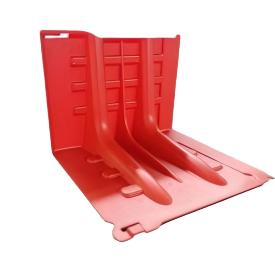
Flood zones rarely follow a neat rectangle. One street might sit high and dry while the next block collects every drop of rain. That's why fixed barrier lengths fail. Our modular panels slide, lock, and stack without cutting or drilling. You can run a tight line along a curved driveway, then break off into two shorter runs around a garden wall. No leftover gaps, no wasted pieces.
The real advantage shows up when water levels shift. A neighborhood that only needed two feet of protection last spring might face four feet after new development upstream. Instead of buying a whole new system, you add rows of the same panels. Each module interlocks vertically and horizontally, so the wall grows upward and outward as conditions change. The hardware stays the same; only the quantity changes.
This approach also simplifies storage and deployment. Panels stack flat on a rolling cart, and two people can carry enough to block a standard door in one trip. When the forecast shifts overnight, you're not searching for a specific length or drilling new anchors. You grab the stack, click the ends together, and make the run as long or as tall as the water demands.
Lightweight Build Makes Single-Person Setup Practical
The weight cut isn't just about the carry from the car. It means the poles and hubs are light enough to lift with one hand while the other guides the clip into place, so you're not balancing a heavy frame on your shoulder just to get started.
Because the structure doesn't fight back, a single person can square the base, raise the legs, and tension the fabric without pausing to rest between steps. The whole sequence becomes fluid instead of a stop-start struggle.
When weather pushes you to set up quickly, that reduced mass pays off. You're not wrestling a bulky bundle; you're walking the frame open, and the canopy settles into position with minimal tugging.
How Interlocking Boards Create a Watertight Seal
A proper seal starts with the joint profile itself. Instead of relying on flat edges that simply butt together, the boards are milled with a tongue-and-groove geometry where the tongue is slightly oversized for the groove. When pressed home, the wood fibres along the contact faces compress against each other, closing off any straight-line path for water to follow. This mechanical interference, combined with a shallow drip channel cut just behind the outer lip, forces any moisture that does penetrate the surface to collect and drain away before it can reach the inner core.
The real barrier, however, comes from the way the boards react to moisture. As the outer face absorbs water, the material swells far more across its width than along its length. This expansion tightens the joint further, pressing the tongue deeper into the groove and squeezing the mating surfaces together. In many designs, a thin strip of compressible sealant is placed in the bottom of the groove before assembly, so that the swelling action compresses this strip into a continuous gasket along the full length of the seam.
Installation details matter just as much as the board profile. End joints are staggered so that no two seams line up, and each cut edge is sealed with a flexible adhesive before being tapped into place. The final result is a surface where water has to work against both gravity and capillary action to move inward, and the few drops that manage to get past the outer lip are trapped in a drainage channel that leads them harmlessly back outside.
Rapid Deployment Scenarios Beyond the Obvious
Most people associate rapid deployment with software pushes or emergency patches, but the real pressure tests happen in places where connectivity is a luxury. Consider a mobile field hospital arriving in a flood-hit valley with no functioning power grid. The team unloads pre-configured communication kits, each one about the size of a carry-on suitcase, and within twenty minutes a secure local mesh links triage tents, pharmacy storage, and a satellite uplink. There is no time for rack mounting or manual config edits; every device pulls its role from a QR-coded manifest, and offline failover kicks in before the first patient is registered.
Another overlooked setting is the short-term manufacturing line set up inside a repurposed warehouse for a three-week production surge. Instead of waiting for IT to provision a traditional network, line managers use ruggedized edge nodes that auto-negotiate VLANs based on the tool type: a label printer joins the packaging segment, a torque sensor joins quality assurance, and a thermal camera joins safety monitoring. Because the entire stack runs from a hardened micro-infra image on local hardware, the line can be torn down, packed, and redeployed at another site in a different country the following month without touching a cloud console.
There are also quiet, semi-permanent cases like a research outpost on a volcanic ridge or a temporary customs checkpoint at a remote border crossing. These spots rarely justify a full data center, yet they need reliable authentication, local data buffering, and scheduled sync back to headquarters. The trick is not faster provisioning scripts but designing for discontinuity: every service must tolerate hours of isolation, reconcile timestamps gracefully, and resume exactly where it left off. Rapid deployment here means surviving the unplanned gap, not just racing through the initial setup.
Field-Tested Durability for Emergency Response Teams
Emergency teams work in conditions that would destroy ordinary gear within days. Mud, debris, chemical exposure, sudden impacts, and relentless abrasion are just part of the job. Our equipment has been dragged through collapsed structures, submerged in floodwater, and scraped against concrete during live rescue operations — and it keeps functioning because every seam, buckle, and housing was built for that exact punishment.
Rather than relying on lab simulations alone, we hand prototypes to active responders across fire, search-and-rescue, and disaster medical units. They use the gear during real call-outs for months, and their feedback drives every revision. If a clasp fails after two weeks of crawling through rubble, it gets redesigned. If a radio housing cracks in sub-zero temperatures, the polymer blend changes. The result is equipment that has already survived the worst before it reaches your team.
That kind of proven ruggedness means fewer mid-operation failures and less downtime for replacements. Teams can focus on the mission instead of babysitting their tools. When every minute counts and every piece of gear must work, field-tested durability isn't a luxury — it's the baseline.
FAQ
Each panel weighs under 30 pounds and folds flat, so a single person can carry several at once and load them into a standard pickup bed without special equipment.
Two people can link and brace a 50-foot run in about ten minutes. The boards snap together with built-in gaskets, so there's no need to fill anything or wait for curing.
Yes. After the water recedes, you just rinse the panels, check the seals, and stack them back in storage. Most departments get at least five to seven seasons out of a set with basic care.
The honeycomb core and reinforced polymer shell handle impacts from branches and small debris. When properly braced, the system resists current speeds up to roughly 10 feet per second without leaking.
You can stack panels vertically with connector clips to reach 20, 30, or 40 inches. Many customers start with a 20-inch base set and add extensions as their flood mapping changes.
Unlike sandbags, there's no heavy filling or disposal problem. Unlike inflatable barriers, there's no pump or risk of puncture taking down a whole section. If one panel is damaged, you swap it out and keep the line intact.
No formal training is required. Most crews get comfortable after a single practice run. We include a one-page illustrated guide and offer optional on-site drills for larger installations.
Yes. The hinge design allows up to 15 degrees of flex between panels, so it can handle sloped driveways, curbs, and gentle turns without custom fabrication.
Conclusion
Time is the one resource flood response teams cannot borrow. This portable combined flood control board system strips setup down to a process measured in minutes rather than hours. Each modular panel clicks into the next using a compression interlock that forces the sealing gasket tight, so water finds no gap at the joint. The boards themselves weigh less than many sandbag loads, which means a single person can carry and position them across a doorway, a loading dock, or a low-lying walkway without waiting for extra hands. That lightweight construction does not sacrifice rigidity: the panels stay stiff under hydrostatic pressure and adapt to uneven ground by adding or subtracting sections as the flood zone expands or shifts.
Beyond the standard door and window barrier uses, the same kit has been deployed to protect underground vents, transformer rooms, and temporary medical tents during flash events. Emergency response teams have tested the boards in repeated cycles of submersion, debris impact, and rough handling, and they keep their shape and seal. Because setup requires no power tools or specialized training, a small crew can cover multiple entry points in the time a traditional barrier would take at one. The result is a flood defense line that goes from truck to working barrier while water is still rising, not after it has already arrived.
Contact Us
Contact Person: Kristin Zhang
Email: [email protected]
Tel/WhatsApp: +8615366239752
Website: https://www.jianghecn.com/