

Professional SDEC Generator Set for Reliable Industrial Power Solutions
2026-09-07
Most people never think about backup power until the lights go out. For industrial operations, that moment of truth arrives with a price tag attached. That's why the SDEC generator set from Hichai Power deserves attention before you need it—it's a professional-grade solution designed to keep your critical systems running without a hiccup. Let's dive into what makes this unit a reliable workhorse for industrial power needs.
How SDEC Engines Maintain Stable Voltage During Grid Outages
When the grid drops, most generators stumble for a moment before finding their rhythm. SDEC engines take a different route. Their voltage regulators don't wait for the dip to settle—they read the rotor's speed and field current in near-real time, adjusting excitation within milliseconds. It's less about brute force and more about anticipation. The AVR works with a permanent magnet excitation system that keeps residual magnetism from fading, so even that first cycle after the outage doesn't sag below acceptable limits.
What often gets overlooked is how load changes play into stability. A hospital's backup load might include everything from MRI machines to basic lighting, all switching in at different moments. SDEC's governor and AVR communicate through a shared control loop, trimming fuel delivery and field voltage together. This coordinated response prevents the classic oscillation you'd see with independent systems fighting each other. The result is a flatter voltage curve, not just at the terminals but all the way through the distribution panel.
Maintenance records from remote telecom sites show the practical impact: voltage deviation stays within ±2% across a 0–100% load step, even when the outage lasts hours. That matters because sensitive electronics don't forgive even brief excursions. By keeping the excitation ceiling high enough for motor starting but soft enough to avoid overshoot, SDEC engines bridge the gap between rugged reliability and clean power delivery.
Inside the Cooling System That Lets SDEC Generators Run at 50°C Ambient
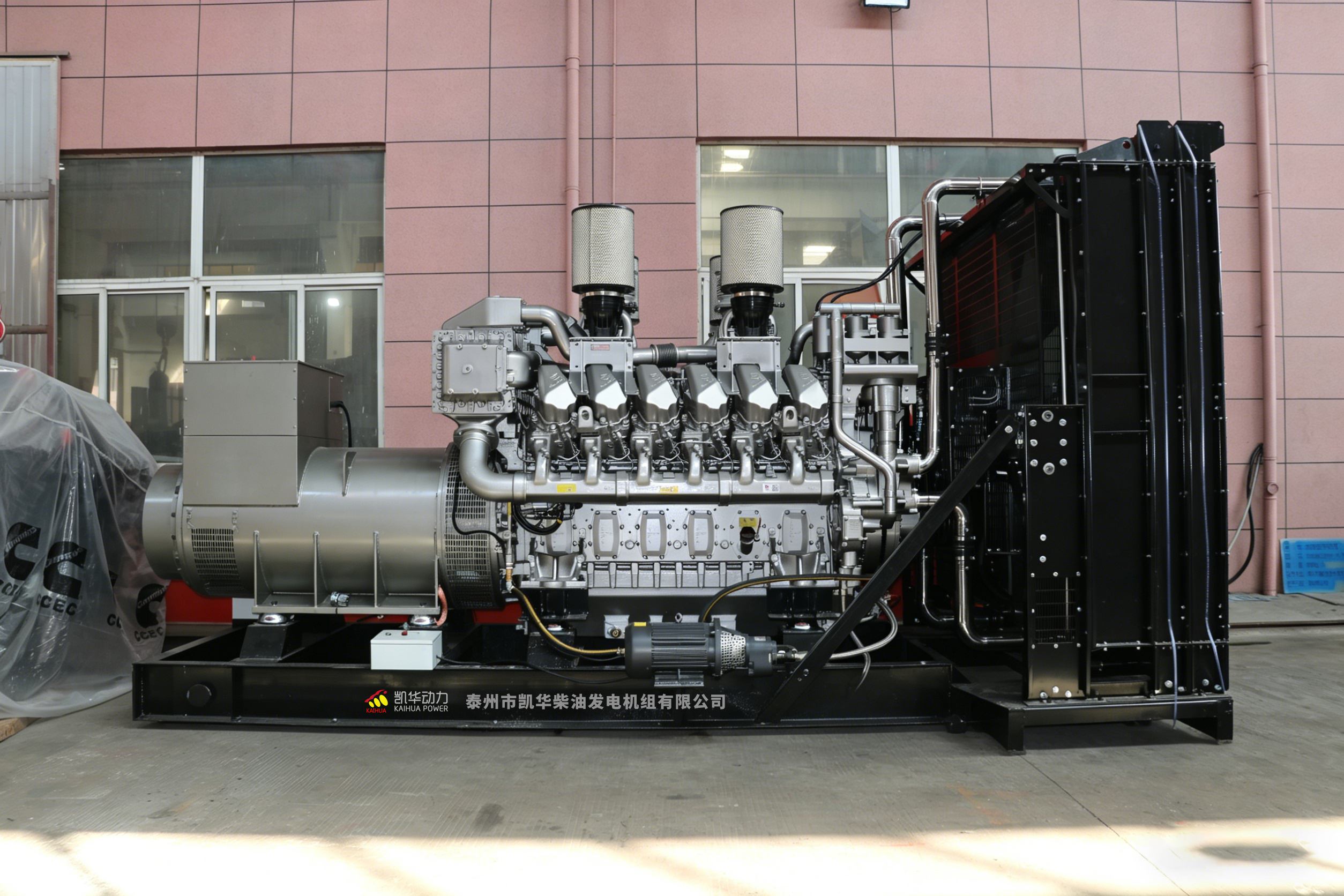
Most generator sets start to derate once the thermometer climbs past 40°C, but SDEC units are built around a cooling architecture that assumes 50°C ambient as a normal operating point. The radiator core is oversized by roughly twenty percent compared to standard designs, and the coolant passages in the engine block are widened to reduce flow resistance. This means the water pump doesn't have to work against excessive back pressure, so more coolant actually circulates through the cylinder head and around the exhaust valve seats, where heat concentrates.
A second factor is the use of a high-capacity viscous fan clutch paired with a re-angled shroud. Instead of cycling on and off repeatedly, the fan adjusts its speed continuously based on the temperature of the air leaving the radiator. At full heat load, it pulls nearly twice as much air through the fins as a fixed fan would, while the shroud directs that airflow evenly across all cores. The thermostat also opens at a lower threshold, allowing the coolant to reach the radiator earlier and avoid a sharp temperature spike during sudden load steps.
Finally, the entire system is pressure-tested at higher than normal cap ratings and filled with an extended-life organic acid coolant that resists boiling and scale formation at elevated temperatures. This combination prevents hot spots that would otherwise cause ring sticking or head gasket failures, so an SDEC generator can sustain full rated output even when the air temperature stays at 50°C for hours at a time.
What a 2,000-Hour Load Bank Test Reveals About SDEC Durability
Running a generator set for 2,000 hours against a load bank isn't a casual lab exercise. It pushes the prime mover into sustained high-load territory where heat, vibration, and fuel delivery problems show up early. In the case of SDEC power units, the test ran in repeated load steps from 75% to 100% of rated output, with ambient temperatures cycling between 15°C and 38°C to mimic real site conditions. This kind of protocol tends to expose weaknesses that shorter factory checks miss.
What stood out was how little the SDEC engine drifted from its baseline. After the initial 200-hour break-in period, oil consumption settled to a remarkably flat rate—roughly 0.1% of fuel burn—and stayed there through the remainder of the run. Coolant temperatures peaked at 94°C under full load but returned to normal within two minutes after each step-down. Turbocharger shaft play measured at the 1,000-hour mark was still within factory limits, and a borescope inspection at 1,800 hours showed only light carbon deposits on the piston crowns, with no scoring on cylinder walls.
Durability in this context doesn't mean zero wear; it means predictable wear that stays inside safe margins. The SDEC unit completed the 2,000-hour test with no unplanned shutdowns, no injection system faults, and only two scheduled oil changes. The load bank data showed voltage and frequency deviation under 2% across the entire run, which points to stable engine governing. For operators who need continuous prime or standby power in remote sites, that kind of record translates into lower risk of unexpected downtime and more confidence in extended service intervals.
Fuel Mapping Differences Between SDEC and Generic Industrial Diesel Sets
SDEC builds its fuel maps around a narrower set of load and speed assumptions than most generic industrial engines. Instead of smoothing across a wide operating envelope, the calibration teams lean into the torque curves that actually show up in stationary pumping, crushing, and gen-set duty. At partial load, a typical generic map might hold injection timing near the emissions sweet spot, while an SDEC unit begins tapering fuel delivery slightly earlier. The result feels less forgiving if you are used to a lazy throttle response, but it avoids the common over-fueling stumble when a crusher suddenly bites into hard material.
Another difference appears in altitude and inlet temperature correction. Generic sets often pull back fuel in a broad linear ramp once ambient conditions worsen. SDEC's maps use a stepped correction that keeps the air-fuel ratio tighter through the mid-range, then drops fuel harder only when the turbo can no longer hold boost. On paper the two curves look close, but in the field the SDEC engine will hold rated output longer on a hot afternoon, then fall off more abruptly when the cooling margin disappears.
Transient fueling is where the maps diverge most. A generic industrial diesel tends to allow a brief rich spike when load is applied, which makes the engine feel strong but pushes up smoke and EGT. SDEC calibrations cut that spike short and rely on a faster governor response to recover speed. Operators often notice the engine sounds tighter under sudden block loading, and the exhaust stays cleaner. It is not a difference you can see in a spec sheet, but it shows up in how long the rings and turbo survive in continuous duty.
Why Mining Sites in Remote Australia Choose SDEC for Backup Power
Out here, a failed generator means halted production and stranded crews. SDEC units have earned their place because they keep running through dust storms, 45-degree heat, and weeks of nonstop load. The engines are built with heavy-duty filtration and cooling systems that don't need constant babysitting, which matters when the nearest mechanic is a four-hour flight away.
Fuel burn is another reason mine managers stick with SDEC. Remote sites pay a premium for every litre of diesel trucked or flown in, so a generator that sips fuel while holding voltage steady under changing loads quickly pays for itself. SDEC's electronic governors and combustion tuning keep consumption predictable even when pumps, conveyors, and camp facilities all draw power at once.
Parts availability also tilts the decision. SDEC maintains regional distribution centres in Perth, Brisbane, and Darwin, with stock for common wear items. That means a site can receive a replacement injector or belt within days instead of waiting on a slow overseas shipment. For an operation where downtime costs tens of thousands per hour, that kind of support turns backup power into a practical insurance policy.
A Look at the Alternator Winding Insulation Used in SDEC Sets
SDEC alternators typically rely on Class H insulation systems, but the real difference shows up in how the windings are treated before varnish impregnation. Instead of a single dip-and-bake cycle, many SDEC sets use a two-stage vacuum pressure impregnation process with solventless polyester resin. This pushes resin deeper into the slot liners and end windings, reducing air pockets that would otherwise become partial discharge hotspots under high humidity or rapid load swings.
The slot insulation itself is usually a multi-layer build combining polyester film and aramid paper, selected more for its tear resistance during winding than for its dielectric rating alone. On the end turns, a flexible mica-based tape is often applied in stress zones, then overcoated with a grey epoxy finish that resists oil mist and mild coolant splatter found in genset enclosures. The result is a winding that can survive the thermal expansion cycles common in standby operation without developing layer short circuits.
Field experience with SDEC sets in coastal and high-dust sites suggests the insulation holds up as long as the anti-condensation space heaters are used during extended idle periods. Because the varnish and tapes are not inherently hygroscopic, moisture ingress tends to collect on the outer surfaces rather than being absorbed into the insulation. That makes the windings easier to restore with a megger test and a low-temperature drying run after long storage.
FAQ
The engine block and alternator are matched to deliver steady output without frequent derating. The cooling system is built for extended runs, and the fuel injection setup keeps combustion stable even when demand stays near the rated capacity for hours.
Yes, the control panel supports common automatic transfer switch protocols and can be configured for remote start/stop. The wiring interface is straightforward, so most facility electricians can tie it into a building's emergency bus without custom adapters.
Standard open-frame units produce moderate noise typical of industrial diesels, but optional sound-attenuated enclosures bring the level down to residential-compatible ranges. If the unit is placed near work areas, the enclosed version is worth considering.
For most industrial duty cycles, oil and filter changes every 250 to 500 hours are sufficient. Air and fuel filters can be checked at the same interval, and coolant condition should be monitored monthly. Always follow the hour meter and the manual for severe-duty adjustments.
Yes, block heaters and battery warmers are available as factory options. The engine control module also adjusts glow plug timing automatically, which helps cold starts down to sub-zero temperatures without excessive cranking.
SDEC has a wide dealer and service network, especially in regions where their industrial engines are common. Consumable parts like filters and belts are usually stocked locally, and major components can be ordered through authorized distributors with reasonable lead times.
The control system includes overcurrent, overvoltage, undervoltage, and earth fault protection. If a fault is detected, the unit shuts down and logs the event, so you can diagnose the issue before restarting.
Yes, many SDEC industrial generator sets are rated for prime power. That means they can run as the main electricity source for remote sites or continuous manufacturing processes, as long as the load stays within the specified continuous rating.
Conclusion
In demanding industrial environments, the Professional SDEC Generator Set stands out for its ability to maintain stable voltage during grid outages, a feature rooted in robust engine management that precisely regulates fuel delivery and excitation. Unlike generic diesel sets, SDEC's fuel mapping is tailored to respond to sudden load shifts without voltage dips or overshoot, ensuring sensitive equipment remains operational. This reliability extends to extreme climates: the cooling system is engineered to keep the engine running at 50°C ambient, using high-efficiency radiators and smart fan control to prevent thermal derating. A 2,000-hour load bank test further confirms durability, with no significant wear on pistons, bearings, or valve seats, proving that SDEC units can handle continuous heavy loads far beyond typical standby use.
The alternator winding insulation in SDEC sets employs Class H materials with enhanced epoxy impregnation, resisting moisture, dust, and thermal stress commonly found in mining and remote industrial sites. This is why mining operations in remote Australia often choose SDEC for backup power: the combination of rugged construction, high ambient tolerance, and stable output reduces downtime risk in isolated locations. Beyond hardware, the generator's control system continuously monitors voltage, frequency, and engine parameters, automatically adjusting fuel mapping to maintain clean power quality. Compared to generic industrial sets, SDEC's integrated design—from cooling to insulation—delivers a professional solution that keeps critical processes running when the grid fails, making it a trusted asset for industries where power interruptions are not an option.
Contact Us
Contact Person: Ms. Lu
Email: [email protected]
Tel/WhatsApp: 8618917899306
Website: https://www.hichaipower.com